Sunday, February 15, 2026

Matthew Harvey Nace: The End

I've uncovered a lot of info about about my 3rd great uncle Matthew Harvey Nace (aka James Hempstead Neyce), the family scoundrel, in previous posts: 

https://nacelithia.blogspot.com/2018/07/matthew-harvey-nace.html

https://nacelithia.blogspot.com/2019/04/matthew-nace-mystery-part-i.html  

https://nacelithia.blogspot.com/2019/04/matthew-nace-mystery-part-ii.html 

https://nacelithia.blogspot.com/2021/02/matthew-nace-another-discovery.html 

nacelithia.blogspot.com/2026/02/matthew-nace-fakes-death.html

To summarize the above posts: Matthew and his wife Evaline already had three children when she died of complications in 1854 while giving birth to a fourth, and Matthew had an enormous tombstone erected for her in Richmond's Hollywood Cemetery. By 1855, he was living in New York where he was soon found to be embezzling from his company, Nace and Coe. When Israel Coe issued a warrant for his arrest, Matthew then absconded and headed west. In Indiana, he married Ella B. Christian (his first wife's younger sister—Elizabeth "Ella" Byrd Christian), scammed some folks in Missouri, headed farther west, assumed the name James Hempstead Neyce, lived in Oregon for a while, had three children, moved to California, and spent some time in prison.  

The Sacramento Bee, p. 5, Sept. 15, 1890

While in prison, Neyce apparently gained favor from his compiling skills. From the San Francisco Chronicle, p. 4, July 13, 1892:


Eventually he was pardoned. The first article below is from The Oakland Tribune, p. 4 May 16, 1894, and the second is from the San Francisco Chronicle, 1894


After his pardon, James H. Neyce continued to live in California (Santa Clara and then Sonoma), became a respected member of his community, worked as a searcher of records, but eventually was buried in a pauper's grave. Apparently, a few years before his death, he had been in ill health for a while but seemed to be improving: 

Petaluma Morning Courier, p. 3.  Aug 13, 1907


When he died on March 10, 1910, reports of his life were greatly exaggerated. In fact, his obituaries were filled with lies. He was never in the United States Army, was not a friend of army generals, was not a Mexican War veteran, was never in Brazil, was never a secretary of anything in Brazil, and—actually born in 1824—was in his 80s, not his 90s:

—The Oakland Tribune

The next one even gets his place of birth wrong. In 1844, when he was only 20—when President Tyler allegedly appointed him assistant quartermaster in the U.S. Army—he was still in Virginia, where he married Evaline in 1847. Their children were all born in Virginia, and in 1850, Matthew and his family were living in Richmond. His wife died in Virginia in 1854. By 1855, he was living in New York, but in 1856, he married Ella in Indiana.  He was never in the Mexican War, and he was out west during the Civil War. He never had "a splendid record" in the military.
  
          
—The Petaluma Courier


—The San Francisco Chronicle

—The Santa Rosa Republican

If reports of his death were greatly exaggerated, a story written about him is even more outlandish. Published in the Santa Cruz Surf and California Farmer (September 1, 1885), "The Ghastly Ride of J.H. Neyce"—about his alleged adventures in Central America—is complete fiction. Neyce was never in the army so he never held the rank of colonel, and never in Central America or South America. Here is the opening of the story as it looked when first published. 


A transcription of the entire newspaper story:
"A Ghastly Ride" 
Several years before the war Col. J. H. Neyce, at present a land broker in Santa Rosa, Sonoma county, but a that time residing temporarily in the British settlement of Balize, Central America, absent on furlough from the United States Army, in which he held a commission, received orders from the department at Washington to investigate a lately reported discovery of a valuable gold deposit in the mountains some distance from Balize. As he was familiar with the work to be done, having previously been employed in South America, he lost no time in making preparations for departure to the district indicated, but when every thing else was in readiness he was confronted by an unexpected obstacle in the difficulty of procuring  trustworthy muleteers, of which it was necessary he should have several. After much discouragement, he finally engaged the services of four natives upon the recommendation of the British resident, who stated that he had employed them and found them faithful, but nevertheless was not assured they would be so under all circumstances. However, as no others could be obtained, and as there was no actual misconduct charged against them, Col. Neyce concluded to look no further, and in due course of time set off alone with the four natives and several pack animals loaded with his baggage and such instruments and materials as might be necessary in his mining investigations and examinations.

Unfortunately, as it proved, the natives did not know the contents of the package, but having heard before starting that their employer was going to the mountains for the purpose of the lately discovered mines, were led to believe that the  baggage contained the purchase money, and being naturally none to honest, the thought of this immense sum, practically in their own possession, excited their own cupidity to the highest degree. However, the first day's trip and night following passed without any indication of evil. as did also the day following. at the close of which some sixty miles of their journey had been accomplished. Their camp that night was made upon a small plateau among the mountains, studded with a few trees, between Co. Neyce, after having partaken of supper, swung his hammock and reposed himself to rest. The natives were to pass the night about the campfire, from which their employer had chosen to remove himself some distance that he might secure more uninterrupted slumber. He fell asleep almost immediately, but after some little time awoke to find the mon shining directly in his face with such tropical brightness that, after trying vainly to go to sleep again, he was forced to change his position in the hammock, lying with his head where his feet had before been. Relieved from the glare of the light, he once more sank to slumber, which continued for he knew not how long, but the awakening from which he will never, should he live far beyond the alloted time of man, be likely to forget.
 A heavy crushing  blow fell upon his left leg, between the knee and ankle, and he awoke—awoke to realize instantly, in spite of the awful shock of such an awakening and the numbing pain of his shattered limb, that he was face to face with death in its most horrible form. Alone and unfriended, amid mountains and wilderness, already disabled and surrounded by four murderous wretches, armed and remorseless, he did not falter for an instant in making one desperate effort for his life. He had acquired in South American the—to residents of civilized communities—singular habit of sleeping with both hands under his head, and in each a loaded revolver. With the same movement, therefore, with which he flung the hammock netting from his face as he rose to a sitting position he leveled a pistol at the mistaken murderer, who was just lifting his machine at what he thought was his victim's head, and the wretch fell in his track. Another was close at hand and sprang forward with his weapon raised, but only to sink to the earth, bleeding and cursing.
Regardless of his wounded limb, Co Neyce now sprang from his hammock, and supporting himself by its cords, raised his pistol to fire at a third miscreant, who was rushing toward him. The weapon exploded, and with the same deadly effect, but at that instant the fourth villain, who stood concealed behind a tree, fired upon the desperate man with an old-time bell-mouthed musket, which he carried. The enormous ball ploughed a furrow across the conel's temple, searing his left eye and destroying the sight forever. Stunned by the terrible shock, he fell to the ground, feeling that it was all over, but a moment later, as the native approached him, he summoned his energies and fired one more shot. The wretch fell with a groan, and the man who had made this desperate fight for life stood among his bleeding, helpless foes a victor.

Victor, and yet unvanquished. Alone and friendless, with the blood streaming from his terrible wounds, it would have been slight wonder had he thrown himself down to die among the wretches who had so foully betrayed him, contented that at least he should not perish unavenged. But he was made of sterner stuff, and he determined not to yield all hope of life, since not yet was the full measure of his vengeance accomplished. With his weapon ready for instant use, and despite the awful agony which the movement caused to his shattered limb, he hobbled from one to another of the fallen men, examining as he might their wounds. Not one had been killed outright, though three were badly wounded and helpless. The fourth was less severely injured, and him his conquerer compelled, with a pistol ever aimed at his head, to arise and do as he was ordered.

One by one his three comrades were bound by the bandit and placedupon the mules which were tethered near, each man being firmly strapped fast to the animal he rode. Then he was also compelled to mount, and Col. Neyce, with a few dexterous twists of a rope, fastened his feet securely beneath his mule's body. With an effort which, in his wounded condition, must have seemed a foretaste of death itself, the American then sprang upon his own animal, and with another menace with is weapon, pointed back the way they had come and uttered the one word, "Vamos!" By this time it was dawn, and the strange and dreadful cavalcade started on its way, the three bound muleteers riding ahead in single file, while behind them came the fourth, with his hands free, that he might the better guide his mule and keep the others on the path. Last of all but keeping ever within a few paces of the strongest of his captives, while his hand held the cocked and ready weapon, rode the American.

It was a march of agony to all. Again and again did the wounded and moaning wretches turn to their captor and beg for a moment's halt, but in vain. With his head burning and throbbing from the pain of his seared and blasted eye, with every motion of his animal causing his gashed and broken limb exquisite pain, feeling that he was slowly dying as he rode, his heart had little room for mercy  for those whose treachery had brought him to this pass. He had ever the same answer, "Vamos!" and at last the miserable wretches ceased to importune him, seeing it was in vain.

Hour after hour went by, the sun rose high in the heavens and beat down with merciless severity upon the already burning wounds of these ghastly travelers: still no halt was made. Their limbs and bodies stiffened, until all sat upon their animals utterly helpless—all but the one scarred and stern-visaged man riding in the rear, whose voice had long since died in his parched and swollen throat, no sign of life remaining save in the deadly menace of his sole remaining eye, and an occasional threatening movement of the hand which still held the weapon, which even now was all that made him master of those who had sought his life. The day passed on. The weary animals, weak from thirst and hunger, grew faint and feeble, but still staggered on, lost now to everything of human sensibility, save the ever-present consciousness of intense and unremitting suffering.

But the end of the journey finally grew near. The town was reached at last, and through its silent and deserted streets, the mournful cavalcade moved, unnoticed until the silent riders halted before the British residency. Lights streamed from the doors and windows, and sounds of mirth and festivity were borne out upon the night air. But they suddenly ceased, for the strange arrival was soon known, and the resident and his guests, most of whom were officers from a couple of British men-of-war lately arrived on the coast, issued in a body from the house and surrounded the silent American, whom some one, despite the awful change in his appearance, had recognized.

Then the iron will,  which for hours past was all that had supplied the place of life, at last gave way, and, without uttering a sound, with one feeble wave of the hand toward his captives, he fel into the arms of his friend, the resident, like one utterly lifeless. And when they lifted the others from their animals there was one who slid through their hands to the earth like a dead fragment of wood, for he had died on the road, and had ridden to his journey's end a stiffened corpse. Perhaps his fat was better than his comrades', for when, the next morning, one of them, thinking to save himself from punishment, confessed the whole conspiracy, the three were taken to the public plaza, and thre ruthlessly shot to death. 

But of the final act of the tragedy, he who they had intended to be their victim knew nothing for many a long day, for it was six weeks until he awakened to consciousness from the burning and wasting fever which had settled upon him. Even then his recovery, though finally complete, was of the slowest, for night after night for long weeks passed without bringing the refreshing slumber his shattered nervous system needed, for to close his eyes in sleep was only to live over the awful passages of that time, and in his dreams to ride again that long journey of torment and death. ~

Here's why this "ghastly" story couldn't have happened: "A few years before the war" doesn't fit Matthew Nace's timeline. A few years before the war, in the early 1850s, he and his wife Evaline and their children were living in Richmond, where he erected a lavish monument for her after her 1854 death. In 1855, he was in New York but soon headed west to avoid charges of embezzlement.  In 1856, he married Ella B. Christian in Indiana. In 1859, he and Ella and his three children were living in Missouri where he'd been scamming people for a while. By 1860, he and Ella are living in Oregon without his children and where—in September 1860—he and five others would climb Mt. St. Helens in nearby Washington. There was no time he could have fit in a career in the army and no time that he could have gone to Central America. The whole story—like much of Matthew's life—is a complete lie.

 Rest in peace, Matthew Harvey Nace/James Hempstead Neyce (1824-1910).

~

Thanks to Jeff Page for providing the clippings.


Saturday, February 7, 2026

Matthew Nace Fakes Death

 At some point in 1867, Matthew Harvey Nace—now known as James Hempstead Neyce and sometimes as Colonel Neyce—faked his own death. While the reason he did so isn't entirely clear, it probably had to do with him either embezzling, owing money, or fearing that someone was catching on to his faked identity.

He first ran into problems when he embezzled from his company, Nace & Coe in 1855 and then vanished, supposedly heading west

The Independent, May 1,  1856

 As he crossed the country, he married Ella B. Christian in 1856 in Vigo, Indiana, and by 1859, used the names Matthew Harvey or J. W. Hays in Missouri where he swindled more folks. (The Randolph Citizen May 1859, p. 2) 

Perhaps he moved even farther west because too many people had caught on to his schemes. Eventually, he arrived in Oregon. According to various stories in Portland's The Oregonian and Dalles' The Morning State Journal, he'd been living in Dalles City, Wasco County, Oregon, for a while. From the May 2, 1863, The Morning State Journal, it appears Neyce was involved in selling real estate:

On September 28, 1863, he ran an ad in Portland's The Oregonian for return of his horse that had been lost for a month. A $50 reward was big money in those days, so Neyce must have been prosperous. 

In April of 1864, he'd even been nominated to run for Wasco County judge, though he didn't win. As of March 1866, he and his wife were still living in Dalles City, Oregon. 

According to The Oregonian (Thu, Mar 07, 1867, Page 3),  In the Circuit Court on March 6th, plaintiff John McCracken won a case against James H. Neyce for $516.66. Perhaps now he was falling upon hard times. Then, seven months later, James H. Neyce mysteriously vanished. 

The Oregonian (Tue, Oct 15, 1867, page 3), reported that the Albany Journal had published this information. "James Hempstead Neyce, formerly of the Dalles, arrived in Albany last week to attend the fair; he was last seen at the fairground on Friday Evening last. On Saturday a pair of saddlebags, containing a lot of medicines and a fine well worn frock coat, were found in the bushes southeast of the pavilion. There is anxiety as to whether any untoward matter has befallen him." [His friends] "were not at first seriously alarmed about this matter; but as time wore on and nothing was heard from him, and as he had failed either to return here or to communicate with a house through which he had ordered goods for the State fair, where it was well known he intended to be, they began some days ago to feel much alarm. The Journal's item was kept from the knowledge of his wife who is in this city, until a telegram of inquiry had been sent to Albany, and an answer received stating that nothing more had been learned of him. It was then thought best to inform her, and, of course she is in great distress at his mysterious absence and silence. Just before the time when he was last seen, he transmitted money to this city for goods which he desired to dispose of at the State fair, and he was expected to either come here for them, or send directions as to forwarding. The firm has heard nothing from him. Grave fears are entertained that he has been foully dealt with. His friends here will be under great obligations to anyone who will communicate any knowledge he may have concerning him."

The mystery of his whereabouts continued through October. From The Oregonian (Mon, Oct 21, 1867, Page 3): "One part of the Mystery cleared up—A letter from Capt. J. T. Apperson, states that the bundle received at the American Exchange last week . . . was left with him by Col. Neyce before he went to the Linn County Fair, and was forwarded by him (Capt. Apperson) when he saw the notice in the papers about Col. Neyce's disappearance. The Albany Democrat of Saturday says nothing more has been learned of the missing man though diligent search has been made by the citizens of Albany." 

From The Oregonian (Tue, Oct 22, 1867, Page 3): "Will the person who left a  small package at the American Exchange Hotel, on Wednesday, the 16th, inst., addressed to 'James H. Neyce,' be so kind as to give information to this office or to the American Exchange Hotel, as to when, and where, and of whom they received said package."

From The Idaho Statesman (Thu, Oct 24, 1867, Page 1): "More Mystery—The mystery which has for sometime surrounded Co. J. H. Neyce seems no nearer solution than a week ago. Nothing whatsoever has been heard concerning him, in either answer either to telegrams, letters or personal search. Mr. S. B. Parrish went to Albany some days ago to prosecute inquiry, but thus far he has sent back no word. On Wednesday to add to the mystery, a package was left by some unknown person at the American Exchange, marked Col. J. H. Neyce, and containing clothes and books which he was known to have taken with him when he left here some weeks since. The package was left, as nearly as is known, about 9 o'clock A.M. One of the employees of the hotel was writing at the front desk when a man came in and without saying a word deposited the package on the desk and immediately went out. No particular notice was taken of it at the time, but towards evening, Mr. Rodgers' attention was called to it, when the address was discovered. It may have been left  with somebody in the country to be brought in, when Col. Neyce was inYamhill county just before the Linn county fair; or its appearance now may have some other meaning. There is nothing, however, beyond conjecture connected with the whole affair.—Oregonian

The Idaho Statesman (Tue, Oct 29, 1867, Page 1) gives some additional details (For some reason, Neyce's name was blocked out in on-line copy): 

In 1868, Neyce was spotted and recognized. According to the Corvallis Gazette (Sat, Jun 13, 1868, Page 2): "The San Francisco correspondent of the Dalles Mountaineer, writing, May 25, says: "Another former resident of Dalles and one who left his mark behind him as well as his hat and coat, at the time of his mysterious disappearance from the Willamette last fall, (Col. Neyce), has been recognized in Vacaville, Solano county, by L. Levy and Washouskey, both known in Dalles, and goes by the name of [Norris?]. He denied his identity, is tinkering watches, and said his wife is in San Jose."

From Idaho Semi-Weekly World (Sat, Jun 20, 1868) : 


A year and half later, from The Oregonian (Wed, Jan 12, 1870, Page 2), this appeared.

However, the Neyces soon must have moved to California. The 1870 Santa Clara census records a J. H. Neice, age 41 and a jeweler; E. B. Neice, age 30; and Bertie Nice, age 4, living at a residence that includes several other people of diverse occupations:


Matthew Harvey Nace/James Hempstead Neyce apparently reinvented himself—with an interesting backstory of his earlier life—and continued to live in California until his actual death in 1910. But that's another story.

Thanks to Jeffrey Page for contributing many of the above clippings.

Previous stories about Matthew Nace have appeared on this blog since 2018:
~

Sunday, August 4, 2024

Two Sisters: Pearl and Lucy Nace

A photo of Annie Pearl Nace (1890-1911) and her sister Mary Lucy Nace (1885-1979). In front of Lucy is her husband, Charles Franklin Mays. Lucy and Charlie were married on 24 December 1902. 


It's hard to tell if the picture was taken before or after after that date, though it was likely taken in summer.
~

Monday, January 17, 2022

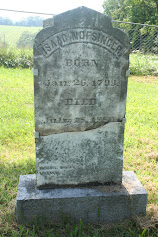
Betsy Nace and Isaac Nofsinger

Members of the Nace family often married members of the Noffsinger—also spelled Nofsinger and Noftsinger—family. For instance, my great-grandfather, John Christian Nace (1828-1928) married Mary Ann Noffsinger (1828-1898), the daughter of Abraham Noffsinger (1797-1887). Abraham Noffsinger was the son of Samuel Noffsinger (1870-1839). Another son of Samuel Noffsinger was Isaac Nofsinger (1799-1880).

Isaac Nofsinger (my 3rd-great-granduncle) married Elizabeth M. "Betsy" Nace (1805-1881), daughter of my 4th great-grandfather, John Christian Nace (1760-1855), and thus my 3rd-great-grandaunt. [Pictures of their gravestones from Findagrave.] 

Isaac and Betsy Nofsinger had the following children: George Lewis (1828-1901); Mary C. (1830-1884); Edwin M. (1833-1906); William James (1834-1895), a private in the Botetourt Light Artillery; Robert Clifton (1837-1906), who served in Botetourt Virginia Light Artillery, Artillery Battalion, Dept. of Southwest Virginia and East Tennessee, C.S.A.; Margaret Hester (1839-1936); and John Samuel (1846-1856).
 
Things did not go well for some of Isaac and Betsy’s children. Their youngest son, John Samuel, died when he was only ten. Two sons went to war, and—while both returned—one suffered the ill effects for decades. Meanwhile, in 1864, General Hunter’s raid burned much of Buchanan, including Mount Joy plantation, where William Nace had been overseer of the iron mill there. (William Nace died the summer before the raid, and his son John Christian Nace settled the estate during late summer of 1863.) I do not know how close the fires came to Isaac and Betsy, but surely they were affected by the number of Union Troops in the area.


Here is the Roanoke Times obituary for Robert Clifton Noftsinger as posted on his Findagrave site: https://www.findagrave.com/memorial/15872165/robert-clifton-noftsinger:


Mr. R.C. Noftsinger, a well-known citizen of this county, who was living with his son-in-law, Mr. W.R. Styne, near Buchanan, shot himself last Tuesday morning about 6 o'clock, inflicting a wound from the effects of which he died in a few moments.
            He was sixty-nine years of age, and was a Confederate soldier in the War Between the States in 1861-1865.
            While in service, he received a wound that seriously affected his spine from which he never fully recovered. His mind becoming also involved, he was sent to the Western Lunatic Asylum for treatment, where he remained until thought to be sufficiently recovered to allow him to return home. But within six or seven years he had to be sent back, when after being under treatment for awhile he was again released, and has not been at home for seventeen years. Instead of improving he gradually grew worse, until the trouble finally culminated in the act which ended his life.
            The deceased was a son of the late Isaac Noftsinger, and a brother of Mrs. J.W. Morgan of this place; was well known in the county, and universally held in high esteem. No reason can be assigned for the rash act, except that of insanity, and a general giving way of health, from long and constant suffering, in both body and mind.
            His wife had already gone before him, and he leaves behind an only daughter, Mrs. Styne, and a sister, Mrs. Morgan, to mourn his unfortunate death.
            He was buried on Wednesday, the 7th, 8 p.m. at the home cemetery, in the presence of many friends and neighbors. —Roanoke Times November 6, 1906.


While neither Isaac nor Betsy was alive when their son committed suicide, they lived through many months of his confinement in Western Lunatic Asylum. 
 
They also  lived through decades of another son’s confinement at home. Edwin M. (Eddie/Edward), age 17, was listed on the 1850 Federal Census for Botetourt District 8, as a farmer by occupation and as “ idiotic” by condition. In the 1860 census, he was still in his parents’ home and was listed as idiotic and unable to read. In 1870, he was the only child in the home of his 71- and 65-year old parents, but there was a 48-year-old woman (Nancie Goode) and an 11-year-old in the household. In the 1880 census for Buchanan, 80-year-old Isaac—now a retired farmer— and 75-year-old Elizabeth had three servants—Nancy Good (55), George Russel (20), and Edward Mickey (12). 

Isaac died on July 18, 1880, after the census had been taken. Elizabeth died six months later on January 9, 1881. After his parents’ deaths, Edwin was likely looked after by family.
 
By the time of the 1900 census, Edwin (age 67) was living with his widowed sister Margaret  “Hester Morgan” (61) in the Fincastle district of Botetourt. Hester’s husband, J. W. Morgan had died in 1899. The census indicated Edwin was disabled and insane. Also in the household were Hester’s daughter Lillie (20), Hester’s daughter Ella S. Hannah (23), Ella’s husband Samuel C. Hannah (30), and a servant George Shanks (35). 
 
Edwin died on May 10, 1906—six months before his brother’s suicide. He is buried in the Godwin Cemetery in Fincastle, VA, where his sister Margaret Hester Morgan is also buried. Isaac and Betsy are buried in the Nofsinger-Styne-Pico Cemetery near Buchanan where many Naces are also buried.

~

Wednesday, June 16, 2021

John Christian Nace: Four Children

NOTE: As of 2026, John Christian Nace's Find a Grave memorials, as well as those of his children, are currently containing two additional INCORRECT children: John Lewis Nace (1841-1918) whose parents are John A. Nace and Mary E. Craft; and Clarisa Catherine "Clara" Persinger (1859-1932) whose attached birth certificate lists her parents as John A. Nace and Mary E. Craft, so she's a sister to John Lewis. Clarisa has popped up before.

While John Christian Nace (1828-1928) had four children, none of his numerous descendants bear the Nace name. 

He and his wife Mary Ann Noffsinger (1828-1880) had only one son, William Robert Nace (1860-1935) whose living children were all female: Mary Lucy (1885-1979), Mattie Blanche (1886-1983), Cora Virginia (1888-1945), Annie Pearl (1890-1911), Ossie Bell (1894-1987), and Zora William (1903-1988). Zora either hadn't been born or was still an infant when this (abt. 1904) picture was taken.


John named his son William after his own father, William Nace (1797-1863). Possibly William's middle name Robert came from John's brother Robert or John's great uncle, Robert F. Nace (1802-1884). In the 1800s, many first sons were given their paternal grandfather's first name. John Christian Nace himself was named after his own grandfather, John Christian Nace (1760-1855).

His first daughter, Hester Elizabeth (1852-1880), probably got her name from John's mother Hester Fringer Nace (1802-1852), Hester Elizabeth married Samuel Huston Lipes, Jr. (1845-1926). Their children were Burk Stolpher (1872-1944), Ella (1876-?), and Otho Graves (1879-1951). After Hester's death, Samuel married again and had several more children.

John's second daughter was Sallie Ann Nace (1855-1921), who married Charles Judson Booze (1857-1927). Their children were Edgar Preston (1880-1960) who married Alberta Claire Phillips (1885-1980), Sandy Virgil (1887-1962) who married Mary Emma Smiley (1890-1984), unnamed baby (1882-1882), John Anderson (1883-1885), Mary Rossie (1889-1960) who married Robert Lee Jones (1877-1932), Rosa Ella  (1893-1980) who married Marvin Griffin Gross (1894-1970), and Minnie Lee (1896-1989) who married Harry W. West (1895-1963).

John's third daughter was Mary Ann Frances, also known as "Fanny/Fannie" or "Mollie" (1864-1933). She was likely named for John's wife, Mary Ann Noffsinger. She married George William Delong (1866-1944). They had a son, William Delong, but not much info exists for him. Possibly he died young; he is not on the 1900 census.

Mary Ann Frances is the daughter that John lived with after his wife died in 1898. Here is George and Fanny DeLong's house in Lithia: 

Picture taken in mid-1960s

John was listed on the 1900 Buchanan/Botetourt census as father-in-law to head of the household, George DeLong and his wife "Molie F":


Two cousins (probably George's) are also members of the household. Next door is John's son William and his family. On the other side is Lucy Spence, Willliam's mother-in-law. William's house was torn down in the early 1950's, but here is the lot where it once stood. Half of the DeLong house is at left:


Despite years of research, I can find no information about any additional children John C. Nace might have had. Therefore, I was surprised not long ago to see some online sites listing two other sons for him: Charles Allen Nace (born in either 1858 or 1862) and Robert "Bob" Calhoun Nace (born in either 1869 or 1873). At least three family trees on Ancestry.com mention one or both in their information about John Christian Nace (but no documentation is provided to prove they are his sons):

https://www.ancestry.com/family-tree/person/tree/112999467/person/352065225438/facts

https://www.ancestry.com/family-tree/person/tree/120166721/person/210185490073

https://www.ancestry.com/family-tree/person/tree/65770830/person/30140900536/facts

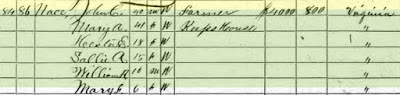
If Bob and Charles were indeed John's sons, they'd likely be on the 1870 census for Buchanan/Botetourt census, but they aren't. Only his four proven children are listed:


There is, however, an 8-year-old Charles Nace in a Sizer household though: 


But what about the 1880 for Buchanan/Botetourt census? Are they there? Nope. Only his two younger children, William and Fannie, are listed. Hester and Sallie would have married and and in their own homes, though Hester might have died by this time. [Note that Mary Ann Noffsinger Nace's father, Abraham, lives next door].  


On the 1880 Fincastle/Botetourt census, though, there is a "Mary Nace" listed with her two children, Charles (age19) and Robert (age 9):


Probably someone saw the Fincastle census, thought "Mary Nace" was Mary Ann Noffsinger Nace, and erroneously concluded the two boys must be sons of John Christian Nace. This might have been how the error started popping up in Nace family trees on Ancestry.

The error involving one of these boys has also popped up on FindaGrave. Bob Nace's site (https://www.findagrave.com/memorial/16165693/bob-nace) lists John Christian Nace as his father and Sarah Ann (Sallie), Mary Frances, and William Robert as his siblings. 
 
UPDATE: As of mid-November 2021, Bob Nace has been removed as John Christian Nace's son on Find-a-Grave. Bob no longer appears on John's children's Find-a-Grave sites as their sibling either.


Because someone linked Bob to John Christian Nace's family, Bob is incorrectly listed as a sibling on each of their sites as well. This grievous error could seriously mess up anyone using the FindaGrave sites for genealogical research:
Pvt. John Christian Nace: https://www.findagrave.com/memorial/15888957/john-christian-nace
Sarah Ann Nace Booze: https://www.findagrave.com/memorial/124420711/sarah-ann-booze
Mary Frances Nace Delong: https://www.findagrave.com/memorial/172711115/mary-frances-delong
William Robert Nacehttps://www.findagrave.com/memorial/210661998/william-robert-nace

Although Bob lived longer than John Christian Nace, he is not mentioned in John's obituary:


We can only hope that whoever added these mistakes to online sources will correct them.
 
NOTE: Another error. As of September 2022, Family Search was listing an additional daughter,  "Clarisa Catherine Nace" (1857/58-1931) but she was the daughter of John A. Nace and Mary E. Craft Nace—not John C and Mary A. Noffsinger Nace. (Info from death certificate; Clarisa was born in 1859 and died in 1932.)
~
Some of my information on the children and grandchildren of John C. Nace comes from a family tree that the late Bill Gross (Zora's son and the last remaining grandchild of William Robert Nace) researched and gave me about 30 years ago.—Becky Mushko


Sunday, February 14, 2021

Matthew Nace: Another Discovery

 I've posted several times about Matthew Harvey Nace, the brother of my great-great grandfather John Christian Nace: "Nace Settlement" when Matthew wasn't around in 1863 to help settle his father's estate, "Matthew Harvey Nace" when I learned about elaborate tomb he'd built for his wife Evaline who died in 1854, "Matthew Nace Mystery, Part I" when I learned he'd absconded with funds from his company and was supposedy sailing to California, and "Matthew Nace Mystery, Part II" when I learned of his further adventures and where he was buried.

Here's a recap: Matthew marries Evaline in Lynchburg, VA, in 1847. They live in Richmond with their three children until Evaline dies following the birth of a daughter in May 1854. Six weeks later the baby dies. Matthew has an elaborate tomb constructed for Evaline in Richmond's Hollywood Cemetery. Matthew's mother, Hester Fringer Nace, dies in the summer of 1854. Matthew and his children are living in New York by 1855 and Matthew is apparently involved in several businesses, including Nace & Coe. But in 1856, Matthew has robbed the company, swindled others, and absconded. His former partner, Israel Coe, places notices in several newspapers. Here's one:

In April 1856, Matthew writes Coe a letter saying he is sailing to California and sending his children to his father (William Nace in Buchanan, Virginia). However, Matthew doesn't sail and doesn't leave his children with his father. Instead, he marries Ella B. Christian—the sister of his late wife—on July 7, 1856, in Vigo, Indiana. By 1857, they are living in Missouri where Matthew is apparently scamming several people.  

The Randolph Citizen, 27 May 1859, page 2


I couldn't find the article in the Fulton Telegraph, so I do not know what his "rascalities" include. But it is likely that he has committed many illegal acts, and thus he leaves the area before he is arrested. No doubt he stops by Lecompton, Kansas, where he leaves his children with relatives. His son William M. appears on the 1860 Kansas census as a member of his uncle William's household. One of the girls ends up with her grandmother.

By the 1860s, Matthew (now James Neyce) and Ella are in Oregon, where they have a daughter Berta Lee (born 1867) and a son James McDowell (born and died in 1868). Apparently they were in Oregon from 1860 to 1868. Then they moved again. See "Matthew Nace Mystery, Part I" and "Matthew Nace Mystery, Part II" for further details of his adventures.

Eventually, Matthew/James does make it to California, where he lives for several years before he is again involved in rascalities and spends some time in Folson Prison. His prison description matches his description in the above newspaper article—right down to the damaged left eye.

Matthew Harvey Nace—"the Expert Scoundrel"—is, no doubt, the black sheep of the Nace family.
~

Thursday, November 12, 2020

A Nace Family Recipe: Light Bread

 This post originally appeared on my "Peevish Pen" blog back in June of 2007 as "Another Family Recipe: Light Bread." Since it's a recipe my grandmother probably got from her grandmother, it's worth posting here:

Grandma's Light Bread

One of the delights of my childhood was going to Grandma’s house on Sunday and smelling her light bread baking. Eating it hot from the oven was even more delightful. She had both a wood stove and a gas stove in her kitchen. She used the wood stove for baking the bread and for most of her cooking. I rarely saw her use the gas stove.

Mattie Blanche Nace Ruble—who lived to be nearly 97—grew up in Lithia, Virginia, but moved to Roanoke when she married a railroad man. Here is a picture of her as a young mother with her three children (Lawrence, the oldest; Raymond, the baby; and Alene, my mother).


Grandma probably got the recipe from her mother, Sulmena Frances Spence Nace, pictured here with her husband, William Robert Nace.


Grandma Ruble’s Light Bread

1 cake or package of yeast
1 tablespoon sugar
1 tablespoon shortening (She used lard but Crisco works)
6 cups plain flour
1 teaspoon of salt
1 pint lukewarm water

Dissolve 1 cake yeast and 1 Tbs. sugar in one pint lukewarm water. Add 1 Tbs. shortening (Crisco) and 3 cups plain flour. Beat until smooth. Then add 1 tsp. salt and 3 more cups of flour—or enough to make a dough that is easily handled.

Knead the dough until smooth and elastic–about 10 minutes. Place dough in greased bowl, cover, and set in a moderately warm place, free from drafts, until light (about 50 minutes).

Punch down dough and form into rolls. Place rolls in greased bread pans, cover, and let rise one hour. Bake 30 minutes in preheated 350 degree oven. [Note: I added the time and temperature that worked for me.]
~~~
I liked the rolls from the corner of the pan—crust on two sides so it held up well for buttering.
~